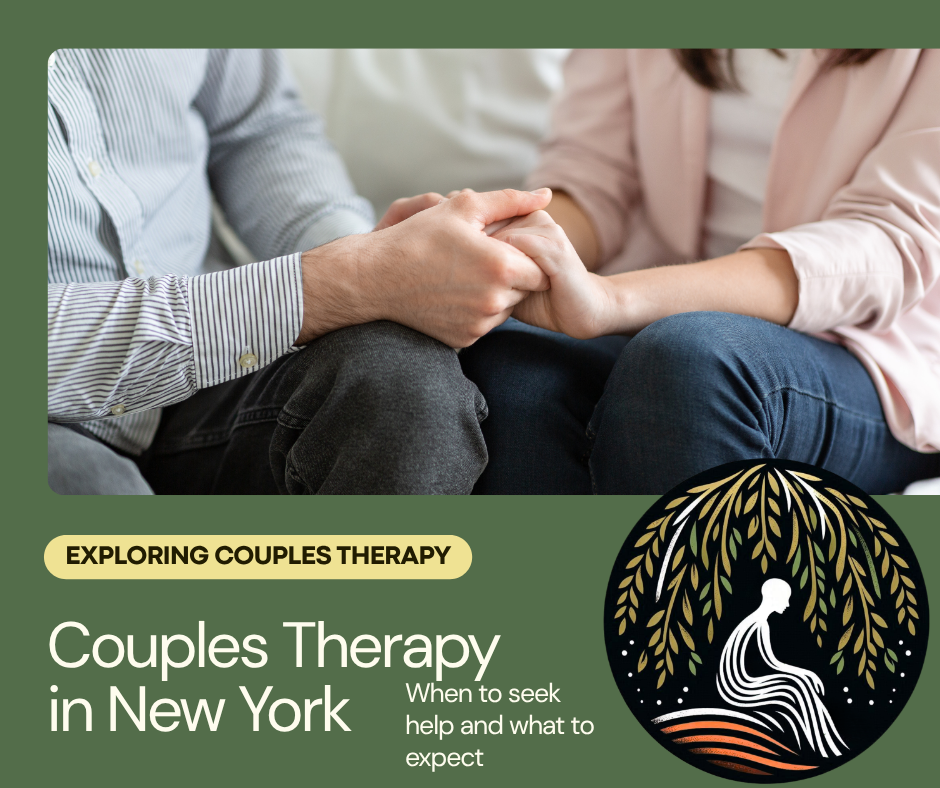
Most couples wait too long. The research here is pretty consistent: the average couple comes to therapy six years after they first noticed serious problems (Gottman & Silver, 1999). By then the patterns are dug in, the resentments have piled up, and one or both partners often have a foot out the door.
It doesn’t have to go that way. Couples therapy in New York works best when you go before you absolutely have to, back when you’re noticing the cracks but still have enough goodwill and curiosity to work on them. Here’s what to know.
When to consider couples therapy
- The same fight keeps happening. Different surface, same pattern underneath.
- You’re growing apart. Less laughter, less curiosity, less time spent together.
- One of you is thinking about an affair, or one already happened. Recovery is possible, but it needs structure.
- A big life change is straining you. A baby, a move, a job change, grief, illness.
- Communication has shut down. You’ve stopped even trying to be understood.
- Your sex life has changed a lot. Frequency, desire, or pleasure.
- One of you is in individual therapy and the relationship keeps coming up.
- You want preventive maintenance. Premarital counseling, post-baby check-ins, that kind of thing.
What couples therapy actually looks like
Sessions run 60 minutes, which gives both partners room to be heard. The structure varies, but most sessions follow a loose pattern:
- Check-in: what’s happened since last time, what’s alive right now
- Name the issue or pattern you’ll work on that day
- Slow down a key interaction: both partners speak, both partners get heard, the therapist helps
- Look at what’s underneath the surface conflict, usually attachment fears, unmet needs, old wounds
- Practice a different way of communicating in real time, with the therapist coaching
- Take something home for the week, usually one small experiment to try
The main couples therapy approaches
- The Gottman Method: research-based, with structured assessment and a focus on the “Four Horsemen” (criticism, contempt, defensiveness, stonewalling) and their antidotes
- Emotionally Focused Therapy (EFT): attachment-based, helping couples spot the emotional patterns underneath their fights and build a more secure connection
- Imago Relationship Therapy: uses structured dialogue to slow conversations down and connect today’s conflicts to childhood patterns
- Integrative Behavioral Couple Therapy (IBCT): combines acceptance with behavior change
- Discernment Counseling: short-term work for when one partner isn’t sure whether to stay or leave
Most experienced couples therapists are integrative. They pull from several approaches depending on what a given couple needs.
Does it work?
Yes, more often than not. Roughly 70% of couples in evidence-based couples therapy show meaningful improvement, and about 50% reach what researchers call “non-distressed” status by the end of treatment (Snyder et al., 2006). That number goes up when both partners genuinely want to be there, and down when one has already mentally left.
Couples therapy doesn’t save every relationship, and it shouldn’t. Sometimes the work makes clear that separating is the right path. Either way, you walk out understanding more than you walked in with.
Insurance and rates for couples therapy in New York
- Most insurance plans don’t cover couples therapy directly as a CPT-coded service. They’ll sometimes cover individual therapy where a partner happens to be present, but pure couples work is usually out-of-pocket.
- Reflections is in-network with Aetna, Blue Cross Blue Shield, Highmark, Carelon, and Cigna for individual therapy. Couples therapy may be covered case by case, depending on whether one partner has a clinical diagnosis. Call our Billing Department to verify.
- Self-pay rate for 60-minute couples sessions is $200.
- HSA/FSA funds can usually be used for couples therapy when at least one partner has a mental-health diagnosis.
Full pricing details are on our Insurance & Billing page.
How to start
Both partners need to agree to come. If your partner is hesitant, the ask that tends to land is a non-defensive one: “I’d like us to talk to someone together. I think it could help me understand you better and feel more connected. Will you come once and see how it feels?”
You don’t need to know what to work on ahead of time. The first session is for laying out what each of you is bringing in, and the therapist takes it from there. Make an appointment and we’ll match you with the right clinician. Either partner can reach out.
References
- Gottman, J. M., & Silver, N. (1999). The seven principles for making marriage work. Crown.
- Johnson, S. M. (2008). Hold me tight: Seven conversations for a lifetime of love. Little, Brown.
- Snyder, D. K., et al. (2006). Current status and future directions in couple therapy. Annual Review of Psychology, 57, 317-344.
- Lebow, J., et al. (2012). Research on the treatment of couple distress. Journal of Marital and Family Therapy, 38(1), 145-168.
Ready to start, without waiting?
Reflections offers no waitlist therapy in New York via secure telehealth. Same- and next-day appointments often available.
Leave a Reply